Learning Together Part 4: West Genesee Budget Thoughts
Hello Camillus!!
The Weather is attempting to resemble spring at least.
Ok, let’s get to it. In Learning Together Part 4, I just want to cover my understanding of the school budget and share some historical trends. We already know the YES! count.
My goal here is to increase my own understanding, while maybe bringing along others who have the same questions. This stuff can be boring, but it is also tied to a bill you will receive for the rest of your days living in Camillus, NY. 👇

I wasn’t going to use the above image because the Yin-Yang symbol typically represents balance, which doesn’t really represent David C. Bills, the West Genesee Board of Education, and interest rates.
I think it would be more watermelon-shaped and turned on its side. 👈
But I digress…
Everything below is just data. You can decide what matters to you.
It hurt my head just spending time with this stuff, but I do know which way I am voting.
Thanks, in large part, to the buy-now-pay-later leadership over there
Lets get the historical trends out of the way:
Tax Levy Raises — Year Over Year
West Genesee’s tax levy has increased every year in this dataset.
Levy increase
Levy increase
Levy increase
Largest levy increase in this set
Levy increase
Tax Levy Raises — Year Over Year
West Genesee’s tax levy has increased every year in this dataset.
These are not isolated increases. They stack on top of each other.
From 2022-23 through 2026-27, the district’s levy increases total:
+$8,342,645
That means taxpayers are not just seeing one annual increase. They are seeing a cumulative levy increase of more than $8.3 million.
The largest single increase was in 2025-26, when the levy rose 3.89%, adding $2,227,953 in one year.
So while the district may point to a 2.34% increase for 2026-27, the bigger picture is this:
The increases keep stacking, year after year.
Budget Jumps
Budget
Largest budget increase in this set
Budget increase
Budget increase
Budget increase
Every year shown includes a tax levy increase. Staying under the tax cap does not mean taxpayers avoided an increase; it means the increase was allowed under the cap formula.
The budget rose from $97.3 million in 2022–23 to $124.6 million proposed for 2026–27. Even when the percentage increase gets smaller, the total budget keeps moving higher.
The proposed 2026–27 levy increase is 2.34%, but that comes after several years of increases. The counterpoint is cumulative impact, not just the single-year percentage.
Debt Service Is Taking Up More Space
One trend worth watching is debt service. In 2022–23, Debt Service/Interfund was about $6.04 million. By the proposed 2026–27 budget, it is over $10.02 million.
That means this line has grown by almost $4 million over the period reviewed — roughly a 66% increase.
Counterpoint: even when the district talks about staying within the tax cap, more of the budget is being committed to past obligations.
Debt service is basically yesterday’s capital decisions showing up in today’s budget, and yes, David C. Bills and the West Genesee BOE was a big part of leading us here.
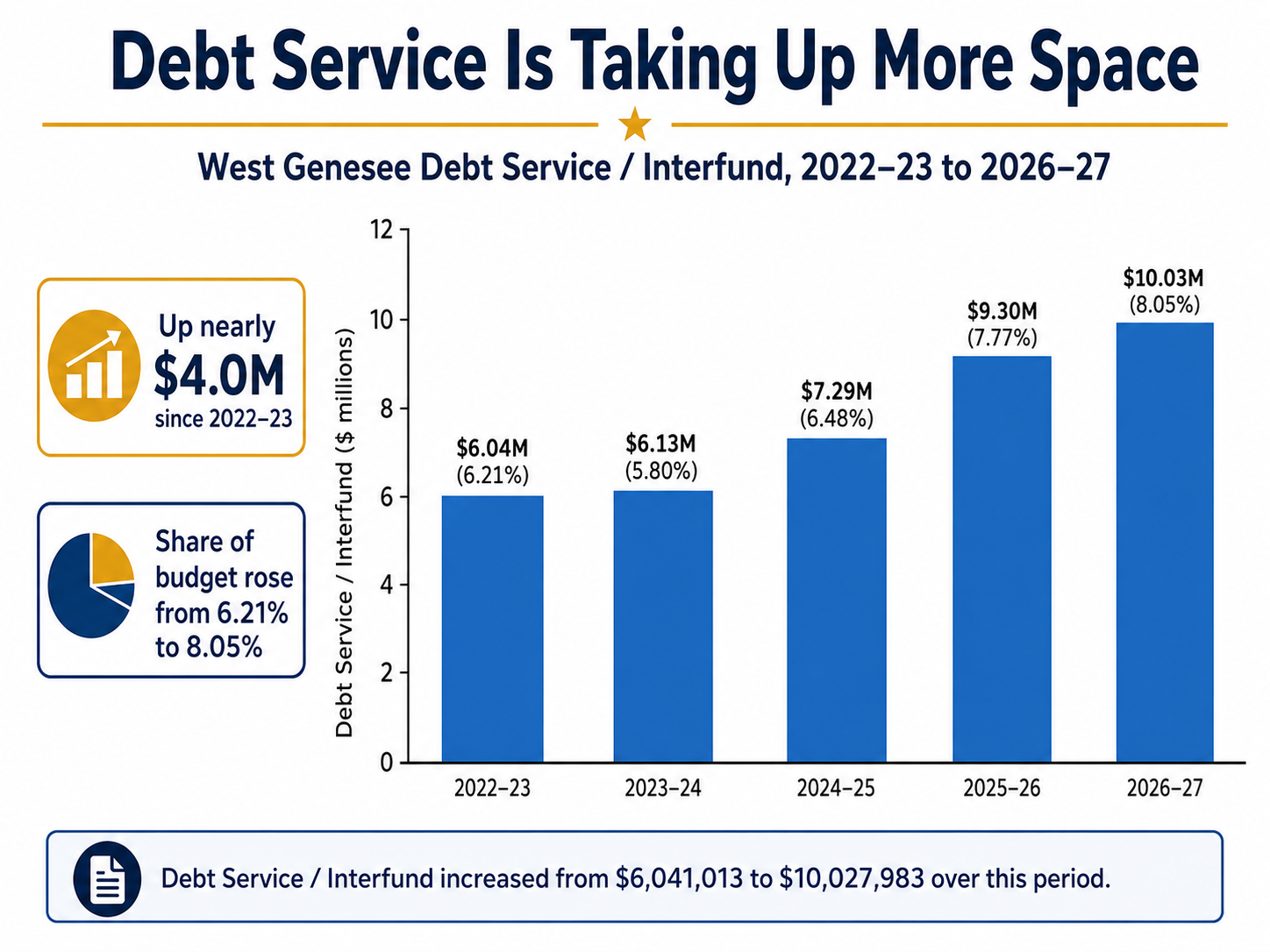
Debt Service / Interfund — Year Over Year
West Genesee’s Debt Service / Interfund line has grown from $6.04 million to just over $10.02 million in this dataset.
Debt Service / Interfund
Debt Service / Interfund
Debt Service / Interfund
Largest Debt Service / Interfund jump in this set
Debt Service / Interfund
What David C. Bills will say is something to the effect of, “You voted on this, kids.”
And technically, he is not wrong.
But in the end, he took all of us here.
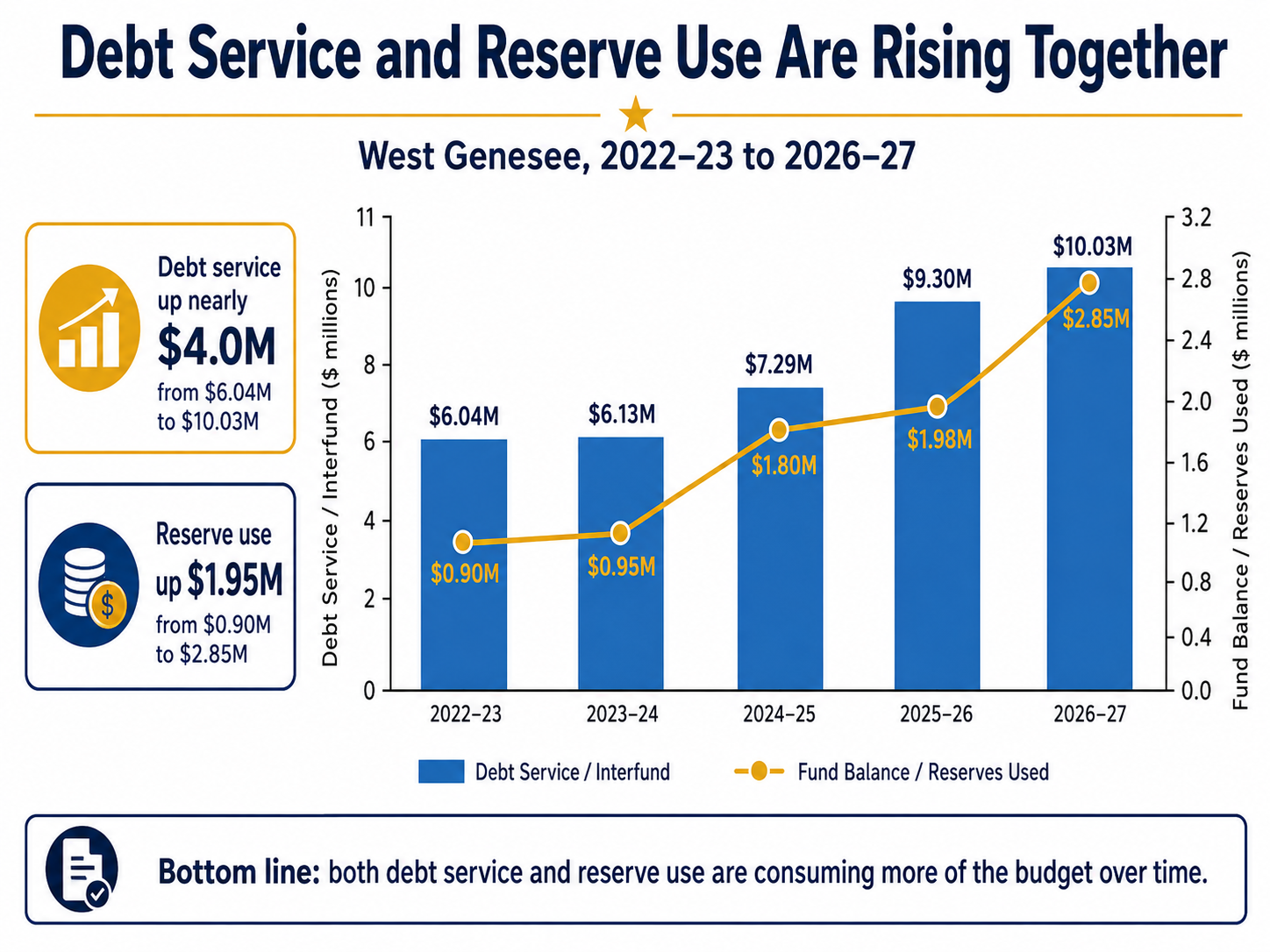
Fund Balance and Reserves — Year Over Year
Fund balance and reserves are being used more heavily to balance the budget.
Fund balance / reserves used
Fund balance / reserves used
Fund balance / reserves used
Fund balance / reserves used
Largest use of fund balance / reserves in this set
⚠️ Why the trend matters
If the district needs more and more reserve money just to balance the budget, then the budget may be balanced on paper without being structurally balanced.
“Local effort” and tax-rate slides can make things look less concerning than the levy trend
💡 Why this matters
The district’s true-value tax-rate history shows the rate falling over time: 23.05 in 2016-17, 20.36 in 2022-23, 15.59 in 2025-26, and a projected 15.96 in 2026-27.
But that can distract from the bigger point:
The tax levy itself is still rising.
Tax rates can fall because assessed value or full valuation changes, while the total levy still increases.
In the end, if this budget passes and you do not get at least a 2.34% raise this year, then you are effectively in EVEN MORE in-debt to the West Genesee BOE and David C. Bills. I mean David C. Bills wont be , but you will.
Lets Talk Contingent Budget:
At first I was mainly concerned with Teachers, Lunch Workers, Bus Drivers etc getting their due. We already know David C. Bills and Christine C. Demass get their due.
It appears that those contracts are set.
and contingency would be more for facility use outside of normal West Genesee school events
In plain English: if an outside group uses the pool, fields, gyms, or buildings, they may have to pay for the actual cost of using them instead of having every taxpayer subsidize it.
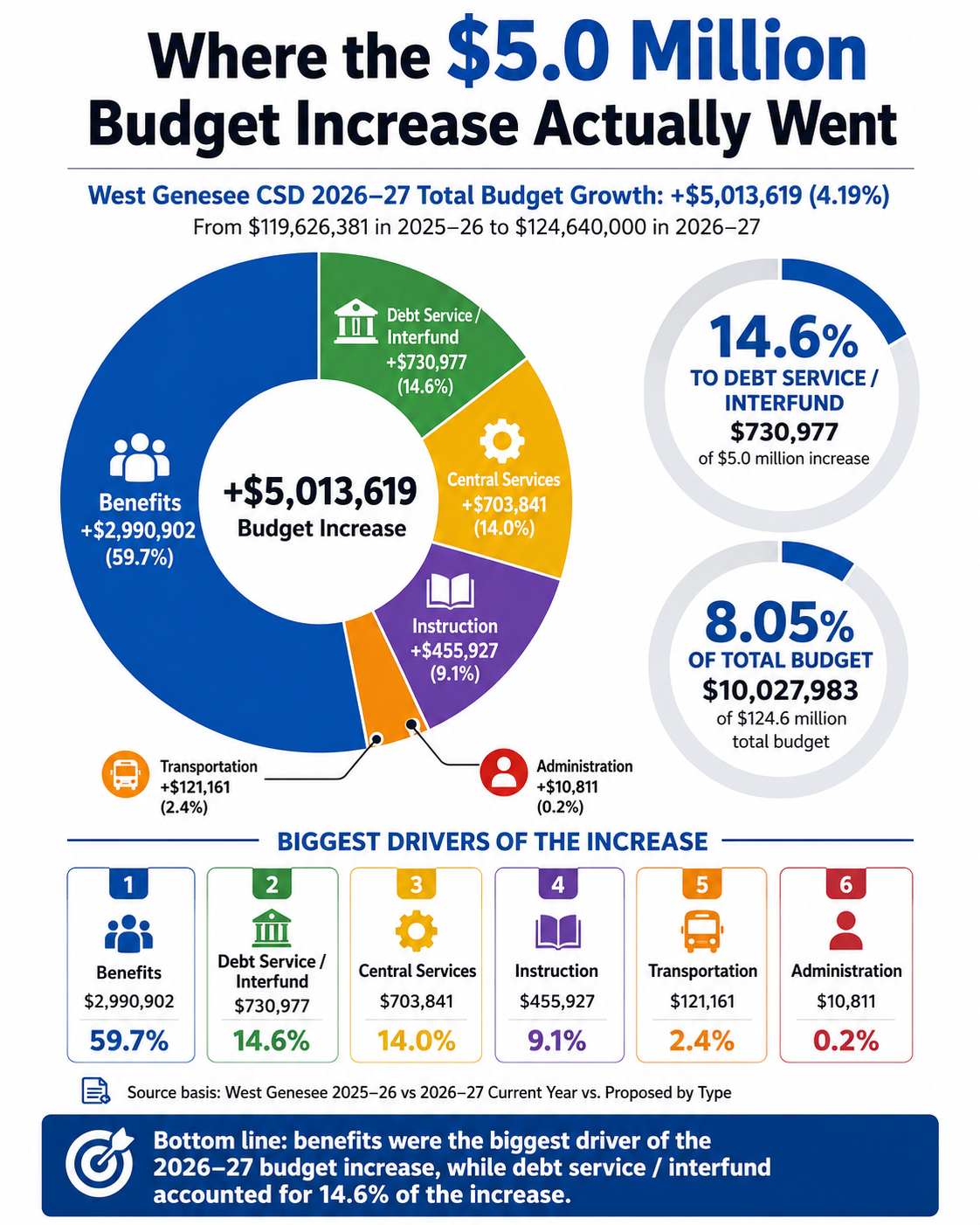
Nearly three-quarters of the 2026–27 budget increase is going to benefits and debt service / interfund before you even get to the rest of the budget conversation.
In 2026-27, benefits account for $2,990,902, or 59.7% of the entire budget increase.
That does not mean employees should not get benefits.
It means the cost structure is getting heavier every year.
At some point, when more and more of the budget is locked into fixed obligations, you can see the crash coming before anyone admits there is a problem.
Maybe someday we will wake up from the David C. Bills and West Genesee Board of Education fever dream of taxation, construction, and marketing. Shiny things wont matter much at that point.
Anyway, if someone sees this and is going to the meeting, I hope it sparks some intelligent debate.
But based on what I have seen from David C. Bills’ answers, I doubt that will happen.
More likely, we will get incomplete answers and attempts to stir up fear
And Just Keep in Mind.
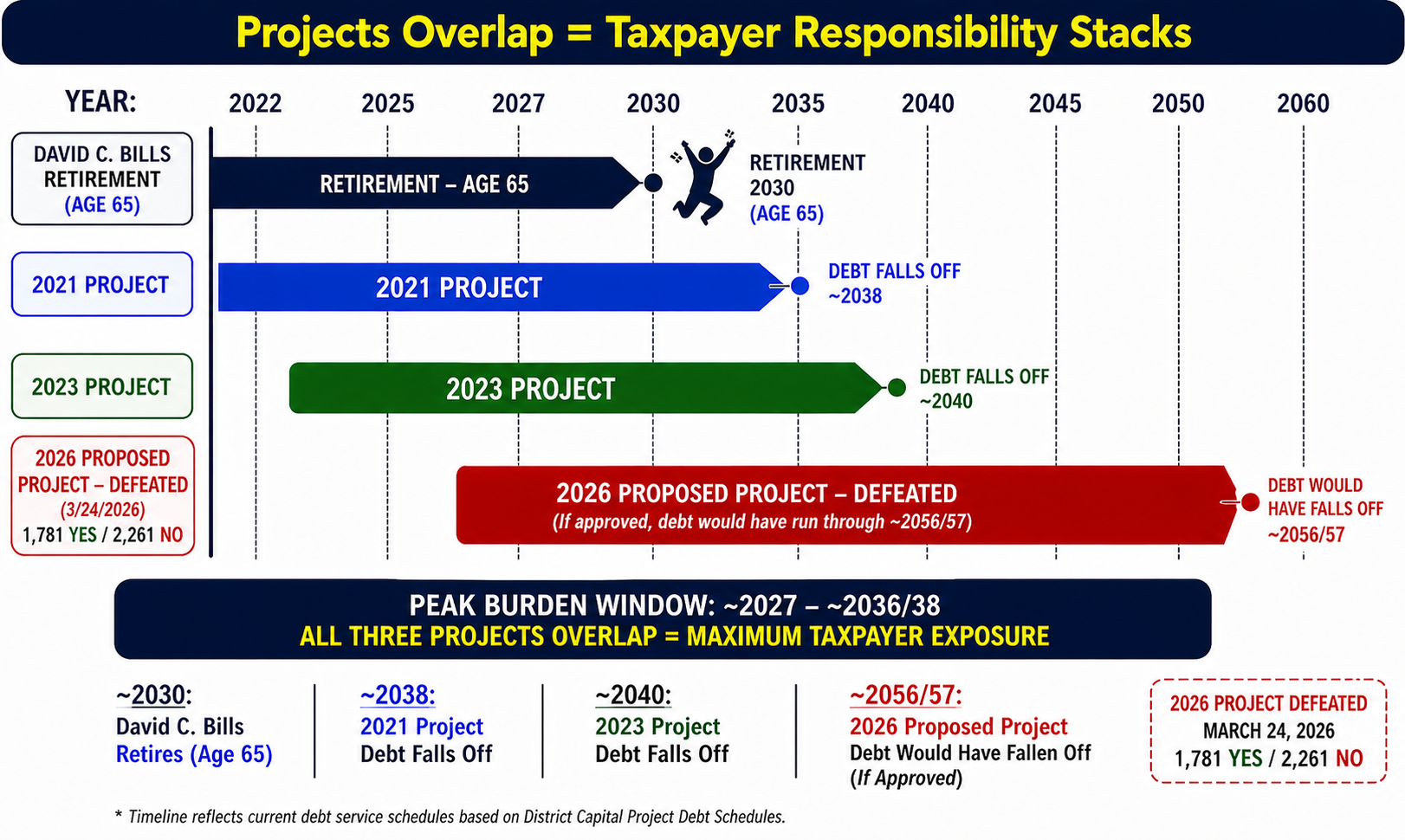
I can't help wonder what the budget would look like with out all the debt?
Peace, Love and Millions
-RTN